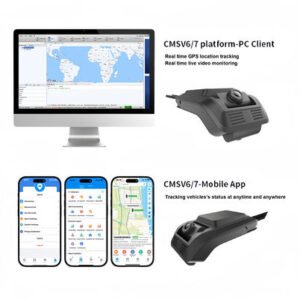
Fleet managers constantly seek solutions that enhance safety while delivering measurable returns on investment. High-definition USB vehicle security cameras represent a significant advancement in this quest, offering superior image quality with simplified deployment. But do these systems truly deliver value beyond their conventional counterparts? This article examines the cost-benefit equation and presents real-world implementation cases that demonstrate their impact on modern fleet operations.
The Cost Structure of HD USB Vehicle Security Systems
Understanding the true cost of high-definition USB vehicle security cameras requires examining both acquisition expenses and long-term operational considerations.
Initial Investment
The entry point for HD USB vehicle camera systems typically ranges from $150-$350 per vehicle for basic setups, with enterprise-grade multi-camera configurations reaching $500-$800. This investment includes:
- Camera hardware (1080p)
- USB power adapters and cabling
- Storage media
- Mounting hardware
Unlike traditional hardwired systems requiring professional installation at $200-$300 per vehicle, USB-powered cameras can be deployed by fleet staff with minimal technical expertise. This self-installation capability alone represents a 15-25% reduction in deployment costs for mid-sized fleets.
Operational Expenses
The operational cost structure shifts significantly with HD USB systems:
- Storage costs decrease by approximately 30% compared to analog systems, as digital compression techniques enable more efficient use of storage media
- Power consumption remains minimal, drawing under 5 watts per camera
- Maintenance requirements decrease due to fewer connection points and simplified troubleshooting
For cloud-connected systems, data transmission costs typically range from $10-$30 per vehicle monthly, depending on resolution settings and upload frequency.
Return on Investment: Beyond the Balance Sheet
The financial justification for high-definition USB vehicle security cameras extends well beyond their acquisition costs, with returns manifesting across multiple operational areas.
Insurance Premium Reductions
A 2024 study by the Commercial Vehicle Safety Alliance found that fleets implementing HD camera systems experienced insurance premium reductions averaging 12-17% within the first year of deployment. For a fleet of 50 vehicles with typical commercial auto liability premiums, this represents annual savings of $20,000-$35,000.
These reductions stem from:
- Improved risk assessment capabilities
- Faster claims resolution
- Reduced fraudulent claims against fleet vehicles
- Documented evidence of driver compliance with safety protocols
One regional delivery company with 120 vehicles reported a 21% reduction in premiums after providing their insurer with a comprehensive safety plan centered around their HD USB camera implementation.
Accident Frequency and Severity Reduction
High-definition cameras impact both accident prevention and post-incident costs:
- Fleets report 20-30% reductions in at-fault accidents within 12 months of deployment
- Average claim costs decrease by 25-40% when supported by high-definition video evidence
- Litigation expenses drop significantly when clear footage establishes liability
The superior resolution of HD systems proves particularly valuable in low-light conditions and when capturing critical details like license plates, traffic signals, and road signage—elements often indiscernible in standard-definition footage.
Operational Efficiency Improvements
Beyond safety and insurance benefits, HD USB camera systems drive operational improvements that directly impact the bottom line:
- Fuel consumption typically decreases 5-8% as driver behavior improves under monitoring
- Vehicle maintenance costs reduce by 3-7% due to more consistent driving patterns
- Driver retention improves as safety records become more objective and defensible
These efficiency gains often surpass the direct safety benefits in long-term financial impact, particularly for high-mileage fleets.
Real-World Implementation: Case Studies in Fleet Transformation
The abstract benefits of high-definition USB vehicle security cameras materialize most convincingly through examination of actual implementations across diverse fleet operations.
Case Study 1: Urban Delivery Service
A metropolitan last-mile delivery company with 85 vehicles implemented HD USB cameras across their entire fleet after a pilot program demonstrated compelling results:
Implementation Approach:
- Deployed 1080p USB cameras
- Self-installation by the fleet maintenance team during regular service intervals
- Integration with the existing telematics platform
12-Month Results:
- 32% reduction in at-fault accidents
- 18% decrease in insurance premiums
- 41% faster resolution of insurance claims
- $94,000 annual fuel savings attributed to improved driving behavior
The company achieved complete ROI within 7.5 months, with the system continuing to deliver approximately $215,000 in annual savings across all benefit categories.
Case Study 2: Regional Trucking Company
A mid-sized trucking operation with 140 vehicles implemented HD USB camera systems specifically to address rising insurance costs and litigation concerns:
Implementation Approach:
- Phased deployment starting with the highest-risk routes
- 1080p forward-facing cameras with optional driver-facing cameras (driver opt-in program)
- Integration with dispatch and route management systems
18-Month Results:
- Successfully defended against 11 fraudulent claims with potential liability exceeding $1.2 million
- Reduced average claim settlement by 37%
- Improved CSA scores by 22 points
- Enhanced driver coaching program with video-based training
The company’s safety director noted: “The clarity of high-definition footage proved decisive in multiple legal proceedings. Details that would have been lost with our previous system were clearly visible, completely changing the outcome of several cases.”
Case Study 3: Municipal Fleet
A city government deployed HD USB cameras across 210 diverse vehicles, including maintenance trucks, utility vehicles, and administrative cars:
Implementation Approach:
- Standardized 1080p USB camera system across all vehicle types
- Centralized management through a secure municipal network
- Integration with the citizen complaint response system
24-Month Results:
- 28% reduction in citizen complaints against municipal drivers
- 44% decrease in accident-related worker compensation claims
- $167,000 annual reduction in vehicle repair costs
- Enhanced transparency in public service operations
The municipal risk manager reported that the system paid for itself within the first year through reduced liability claims alone, with operational improvements representing “pure savings” in subsequent years.
Implementation Considerations for Maximum ROI
Maximizing the return on investment from high-definition USB vehicle security cameras requires strategic implementation decisions that align with specific fleet characteristics and objectives.
Resolution Requirements
While “high-definition” encompasses multiple resolution standards, most fleet applications find optimal value at 1080p (1920×1080 pixels). This resolution provides:
- Sufficient detail for license plate capture at normal following distances
- Clear visibility of traffic signals and road signage
- Reasonable storage and transmission requirements
The jump to 4K resolution (3840×2160 pixels) quadruples the data requirements while providing marginal additional value for most fleet applications. Reserve 4K systems for specialized needs where extreme detail is essential.
Storage Strategy
Storage architecture significantly impacts both costs and benefits:
- Local storage offers the lowest ongoing costs but requires manual retrieval
- Cloud-connected systems provide immediate access but incur monthly data transmission expenses
- Hybrid systems that upload only tagged events or operate on exception-based rules often deliver the optimal balance
One logistics company reduced their data costs by 72% by implementing smart uploading that transmitted only speed violations, hard braking events, and driver-tagged incidents rather than continuous footage.
Integration Capabilities
The most successful implementations integrate camera systems with broader fleet management infrastructure:
- Telematics integration correlates video with vehicle performance data
- Maintenance systems receive visual verification of vehicle condition
- Driver scoring programs incorporate video-based evaluation
- Route optimization tools utilize road condition footage
These integrations multiply the value of the camera investment by extending its utility beyond safety and liability protection.
Conclusion: The High-Definition Advantage
High-definition USB vehicle security cameras deliver compelling value for fleet operations through a combination of reduced costs, enhanced safety, and operational improvements. The simplified deployment model eliminates traditional barriers to adoption, while superior image quality transforms the camera from a passive recording device to an active management tool.
For fleet managers evaluating these systems, the evidence suggests that the question is no longer whether they deliver positive ROI, but rather how quickly. With properly implemented systems consistently achieving payback periods under 12 months, high-definition USB cameras represent one of the most financially sound safety investments available to modern fleet operations.
The real-world case studies demonstrate that benefits extend far beyond the obvious insurance and liability advantages, creating cascading improvements across multiple operational dimensions. As one fleet manager succinctly stated, “The cameras paid for themselves the first time they exonerated one of our drivers from a false claim. Everything since then has been pure profit.”